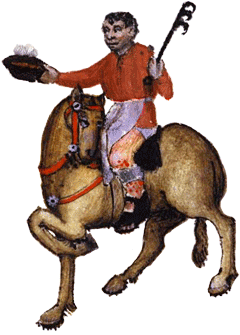
A COOK they hadde with hem for the nones,
To boille the chiknes with the marybones
And poudre-marchant tart and galyngale;
Wel koude he knowe a draughte of Londoun ale;
He koude rooste and sethe and broille and frye,
Máken mortreux and wel bake a pye.
But greet harm was it, as it thoughte me,
That on his shyne a mormal hadde he,
For blankmanger, that made he with the beste.
To boille the chiknes with the marybones
And poudre-marchant tart and galyngale;
Wel koude he knowe a draughte of Londoun ale;
He koude rooste and sethe and broille and frye,
Máken mortreux and wel bake a pye.
But greet harm was it, as it thoughte me,
That on his shyne a mormal hadde he,
For blankmanger, that made he with the beste.
Geoffrey Chaucer for many literary scholars is none else but the father of English literature. Although he has produced many literary works (which include The Book of the Duchess, the House of Fame, the Legend of Good Women and Troilus and Criseyde), today he is most famous for his creation of the Canterbury Tales.
Naturally, as he is a very famous poet, I became interested in how he describes food and what people ate in his works. They ate mostly wafers, cake bread, fish, herbs and greens. The favourite drink of the period in the Canterbury Tales was wine and ape-wine, which made the drinker behave just like an ape.
Some examples for food in the tales include the following ones:
"Wel loved he by the morwe a sop in wyn;" - Prologue to The Canterbury Tales
"As ever moote I drynken wyn or ale" - Thw Wife of Bath's Tale
'And brynge us breed and wyn ful prively." - The Pardoner's Tale
"No wyn ne drank she, neither whit ne reed;" - The Nun's Priest's Tale
"And for to drynken strong wyn, reed as blood;" - Prologue to the Canterbury Tales
"And eek the wyn, in al this melodye" - The Squire's Tale
"Strong was the wyn, and wel to drynke us leste" - Prologue to The Canterbury Tales
"They fette hym first the sweete wyn" - Sir Thopas
"The spices and the wyn is come anoon" - The Squire's Tale
As it is noticeable, Chaucer wrote his work in a slightly more modern version of English than the poet of Beowulf, for contemporary readers of English, deciphering Chaucer's lines and message takes some time. Because of all these linguistic difficulties and the application of the accentual syllabic meter, the author of this blog will only attempt a short version of hat Chaucer might have said of the food in his works:
"Why hav' I wryten my wook you may staat to wonde,
Ceetainle I am noow the wyne and foode influence unde'.
I hav' eaten all thee waferes and fishes and finish'd me wyn,
shall thee not wante to looke drunke, don't drinke after nine."
Imagine that Chaucer is sitting in the middle of the table and he is telling the poem above.

Below you can find The Cook's tale read aloud:
In this video, you can see how some students became inspired by the story and acted out their own rendition of the Cook's tale:
Sources:
http://www.luminarium.org/medlit/cookport.htm
http://neoenglishsystem.blogspot.co.uk/2010/09/what-are-salient-features-of-chaucers.html
http://en.wikipedia.org/wiki/Geoffrey_Chaucer
http://www.godecookery.com/chaucer/chfoodw.htm

Nincsenek megjegyzések:
Megjegyzés küldése